
Gesture Training with Shimmer3R — and a Glimpse of Verisense
In this demo game, I’m holding a Shimmer3R device and using motion gestures to trigger different spells on screen. The fun part is that the gestures are trainable — I can record a gesture for each of the three spells, and the game then tries to recognise them when I repeat the movements.
Under the hood, the Shimmer3R streams gyroscope data from the X, Y, and Z axes. When I perform a movement, the app captures that short segment of motion and compares it against the gesture that was previously recorded for each spell.
The matching is done using Dynamic Time Warping, or DTW. DTW is useful here because two gestures can have the same overall shape but happen at slightly different speeds. For example, I might perform the same wrist flick a little faster or slower each time. Instead of comparing the two motion signals point by point, DTW allows the signals to stretch and align in time, so the app can focus more on whether the movement pattern is similar.
Each comparison produces a DTW distance. A smaller distance means the new gesture is more similar to the trained example. The demo uses a threshold value to decide whether the match is close enough to count as a spell. Lowering the threshold makes the matching stricter, which helps reduce accidental spell casts. Raising the threshold makes the game more forgiving, but it may also increase false matches. In the demo, this threshold can be adjusted using the DTW match threshold slider, so it is easy to tune the balance between sensitivity and accuracy.
The demo video shows this working with a handheld Shimmer3R, but the picture of the Verisense wrist sensor below points to where this could go next. A snug wrist-worn sensor makes this kind of interaction feel much more natural.
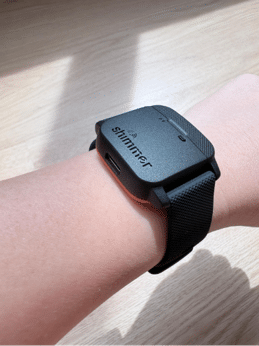
One practical future use case is sports training. Imagine a coach recording a good racquet swing, and then you practice on your own while the wrist sensor checks how closely your movement matches that reference. It could give real-time feedback on consistency and help turn a correct movement into something repeatable. The same idea could also apply to rehabilitation, ergonomics, physical therapy, gesture-controlled interfaces, or any workflow where repeated movement quality matters.
This is only a simple demo game, but it shows how wearable motion data can move beyond recording — towards feedback, training, and interaction.